Wees jezelf; de rest is al bezet.
— Oscar Wilde
Dit is het eerste bericht op mijn nieuwe blog. Deze blog is pas net opgericht, dus kom snel terug voor meer. Meld je hieronder aan om een bericht te ontvangen wanneer ik nieuwe berichten plaats.
Wees jezelf; de rest is al bezet.
— Oscar Wilde
Dit is het eerste bericht op mijn nieuwe blog. Deze blog is pas net opgericht, dus kom snel terug voor meer. Meld je hieronder aan om een bericht te ontvangen wanneer ik nieuwe berichten plaats.
We have come to the end of the course medieval philosophy, and a fitting end it is. We end with political philosophy and ethics, just like Al-Farabi would have done through his enumeration of the sciences. But in this blogpost, I want to shortly reflect on what this course has meant to me.
In general, I think this course has really broadened my mind about the medieval period. Very alas ‘the medieval period as given during high school’, I had been somewhat guilty of believing it to be a very backward time when all that was happening were serfs being exploited and crusades being undertaken. Well, this course has shown me how wrong I was. We have encountered ingenious thinkers and arguments, who have created the foundation for all thinking afterwards. Medieval scholars already talked about the extent to which should citizens should obey to rulers, centuries before Hobbes for example wrote about this. We can see signs of modern communism in the bible and writings of medieval thinkers on voluntary communism. Marx can say religion is the opium of the people all he wants, but his solidarity looks an awful lot the act of charity to me. We see what it means to be virtuous, long before Wollstonecraft based her vindication of the rights of women on achieving virtue. We do well to acknowledge that many of the principles which underly our modern society can be found in medieval thinking.
The course has also introduced me to knowledge about Jewish and Arabic philosophy/theology, things I had little knowledge about. These have also influenced our Eurocentric thinking in a way I think many people have forgotten, so I am glad to have been thought about them during this course.
Furthermore, I am a devout atheist, but this course has made me wonder about the existence of God. We have come across many different arguments about the existence of God, theodicy and other religious doctrines, and sometimes they did stop me in their track and think, ‘hey, maybe they’ve got a point here’. I was especially taken aback by Thomas Aquinas’ argument on philosophy and theology, this indeed made me wonder where my own knowledge comes from. How much does me accepting knowledge from a textbook differ from somebody else accepting knowledge from the bible? What I find very special about this course (and philosophy in general), is that I catch myself looking around at all the beauty we can find here on earth and indeed wonder, isn’t there something who must have created all of this? This is not something I used to do before. Though I am still an atheist through and through, the course has given me a more respect and insight towards the three Abrahamic faiths.
Today we are discussing one of the most influential theologians and philosophers throughout time: Thomas Aquinas. We focus on his union of reason and religion. Aquinas argues that new knowledge in theology is obtained through revelation. Revelation is the process where divine truth is communicated to humans through God. But how is thinking of something new and saying God must have communicated it to you, an actual truth? I can say a supranatural authority has appeared to me in a dream and declared that I am the queen of the world, but this does not actually make it true. Just as a book saying a man was able to part the entire Red Sea, does not make it true.
Aquinas argues that both philosophy and theology make claims of truth based on faith. Sure, most of the new knowledge I obtain has been given to me by other authorities that I have faith in parents, teachers and books. I have faith that what my lecturer tells me is true. But I find there is a difference between a lecturer telling me how the devaluation of a currency leads to inflation, and a book telling me 2000 years ago a man died and then magically came back to life after 3 days? Yes, I have faith my econ teacher is telling me the truth, but this is because I can logically argue that when a currency devaluates, you can buy less with the same amount of money, leading to inflation. There is no way that I can logically explain the resurrection of Christ.
I do not pretend I discover truths myself, just that some truths seem to have more merit than other. I also do not pretend that my secularized upbringing did not give me presuppositions: Yes, I believe God does not exist. But just having faith in a truth is not a form of proof. There is no actual evidence God exists, people might say they have witnessed divine intervention, but until I see it myself, I will never believe it to be true. I do not pretend I can argue with a brilliant mind like Aquinas’s, but for me, revelation does just not seem a good enough justification for a truth. And until somebody convinces me that revelation is just as reliable as the scientific method, I will continue to not be convinced.
Today I will be doing something a bit different, I will be writing a reaction to something said in the lecture. In the lecture was mentioned how some people find shopping to be therapeutic, and that those people are shallow and superficial. I will make an argument why people are allowed to find shopping just as therapeutic as philosophy.
Philosophy is described as the remedy to the illness of the soul. How something changes inside you when you do philosophy, because it allows you to feel more certain, satisfied and complete. I do not doubt that philosophy brings this to some people, but not everybody has a mind inclined to do so. Most people are different, they have other things they use as therapy. For example, sometimes you have these days you are just feeling really out sorts, and you want to crawl back in bed and wallow. Will thinking about Nietzsche’s Genealogy of Morality make them come out of bed? Of course not! They will fall into even deeper despair. When an important occasion is coming up, a lot of people will feel more certain about themselves if they have bought for example a ‘special dress’. They will put it on and get that extra piece of confidence to go out into the world and do what they have to do. Can you call a person superficial if this is what they need to preform well?
Philosophy has also left me with a lot of stress, but maybe that is because my way of doing philosophy is linked to obtaining credits and receiving grades. Especially during exam weeks, when I usually have up to 8 exams, I feel a lot of pressure. Does it make me shallow that during a study break I scroll through the entire Zara website and order a nice top? Is it superficial that I will wear this top to my medieval exam to get that extra confidence boost?
Sure, what philosophy does have over the act of shopping is that philosophy is also a mode of living, it allows you to live and respond to real life. I agree with this, the little time I have been studying it, it has already changed my outlook on a lot of things in live. But some of us need more, some of us need that little extra thing to make us feel better, and this is what shopping does.
Ask a person about the Age of Enlightenment and they will undoubtedly tell you about how this was the period when reason became the main way to obtain knowledge. Sometimes it even seems like people believe that during the Enlightenment reason was invented! As if it had never existed before only now came in to being because of people like Spinoza. This believe is of course quite ludicrous. If previously reason was not the main way to obtain knowledge, what was? If we only obtain knowledge trough for example our senses, how could we ever arrive at conclusions about what we have sensed?
We once again find a classic case Europe believing they are the center of everything, which of course is ridiculous. Let’s take the Jewish philosopher Saadia Gaon who lived many centuries earlier when the French were being attacked by Vikings and organized by manorialism. In the meanwhile, Saadia was already emphasizing on the importance of reason in obtaining knowledge. For him reason also played an important role in religious matters, but this is reason nonetheless. The idea that reason is a tool to overcome doubt and through this live as happy individuals in certainty seems like an idea Enlightenment thinkers would embroider on a pillow.
Not just his emphasis on reason proves him having a very advanced mind, his interest in discovering authenticity of a text reminds me of the Academic skills courses I take now. Here, thinking about the validity and reliability of data and sources plays a very important part. To think that Saadia was already engaged with these kinds of things is really amazing. Of course, looking at the authenticity of a report given by a prophet many years ago is very different from a research paper written by John Mearsheimer I have to read, but it comes down to the same. Through reason the content of a text must be examined and judged for its validity. I of course do not have to use the laws of revelation when the laws of reason fall short, but maybe I should. Some people treat thinkers like Marx like they were actual prophets, so maybe we could also use a bit of revelation in our thinking to obtain an extra dimension to our knowledge.
From the day we are born, we learn. We have been taught to speak, think and act in certain ways. We go to school and they will tell you: this is how history happened, this is how math works and this is how our society works. We learn and we study, and we accept that what our schools and universities tell us is true. Sure, at university you are asked to critically think about what is being taught, but often this has only to do with formulating your own opinion on a subject. We are not doubting whether the actual substance of the information given might be false, but rather if you agree with it or not. When I am being told about Plato’s world of ideas by my Ancient professor, I immediately accept ‘this was a doctrine Plato formulated and this is how it worked’. I might be critical of the concept that everything in the ‘real world’ is an abstract of an idea (which to me seems ridiculous), but I never doubt that it is not true such a doctrine existed.
I wonder, do we ever stop and think whether everything we think we know is in fact, true? We now have all this evidence that the earth is in fact round, but who is to say we are not just floating in a marble owned by an alien like in the Man in Black movie? We have built up all this knowledge over the centuries, and because we have been doing it for such a long time, we think everything we know now is almost certainly true.
We also have had to reject things we believed were true, only strengthening the idea that what we after rejecting think is true, is extra true.
I am not saying everything we know is not true, but maybe we should wonder if that what we think we know may sometimes be false. This is something we can learn from Al-Ghazali and his incoherence of the philosophers. In his work he shows that philosophers build their own doctrines on ideas of other philosophers, believing these ideas to be true. He shows that popular philosophical propositions that have been accepted for centuries, were based on unproven premises. Philosophers were not saying anything new; they were just imitating each other. Maybe this is what we all are doing, because let’s face it, not many people are capable of complete independent and original thought. We learn things and from this build our own conception of the world, which is just an imitation of all you’ve been taught. Al-Ghazali has shown that we cannot just reproduce knowledge and never doubt whether it was true. Even now when we think we know so much, it is time to stop and think if this is indeed the case.
“It is wrong for the virtuous man to remain in the corrupt polities, and he must emigrate to the ideal cities, if such exist in fact in his time. If they do not exist, then the virtuous man is a stranger in the present world and wretched In life, and to die is preferable for him than to live.”
This passage from Al-Farabi’s Aphorisms of the Statesman is interesting to look at, especially centuries after it has been written.
All around the world we still see people that speak up for their believes facing prosecution and having to flee to more open societies. Al-Farabi in his political philosophy made a plea for establishing societies were forward thinkers were welcomed with open arms and celebrated. He skectched the kind off society we would need for this.
Al-Farabi like some ancient philosophers believed that people should strive for happiness or sa’ada. People would reach this when they would seek the truth and lead a life of virtuous contemplation after which they would find sa’ada. A political regime should allow and facilitate that people were able to live these virtuous lives so they might one day obtain sa’ada. The head of such a political regime must be a person who is the source of all power and knowledge, sort of a philosopher-prophet. For Al-Farbai many states lose sight of sa’ada and persue other things such as wealth or survivial, they have lost sight of sa’ada. We ourselves might wonder in what kind off state we live now.
The western world is mostly capitalistic, so we could assume we live in vile states, which persue wealth. But our society pursues many more things that keep us from reaching sa’ada. We seek pleasure, not just debauchery but things like watching Netflix for 8 hours straight provides people with some feeling of pleasure (otherwise why do we do it?), so maybe we live in the base state? Or do we live in a despotic state, were we seek to have power over other people? We may not live in a state of necessities anymore, but if we were to live in this state we would not yet be corrupted to pursue wealth or power. We live in a democratic state, were we seek to be free, to do as we wish. Our society holds promise for Al-Farabi we one day might become a virtuous state. The democratic state is distinct by her diversity, because people here can pursue their freedom which attracts a lot of different people. Which means that there might even be some virtuous citizens living amongst us, who might succeed in persuading the others to go and seek sa’ada.
We see in this that Al-Farabi is way more positive about democracy than Plato or Aristotle ever were. This brings us to interesting ideas. A common argument by ignorant people to explain turbulence in the Middle East are things like: ‘maybe democracy and Islam just do not go well together’ etc. But what Al-Farabi shows is a combination of Islam with political ideas that one can only find in Europe centuries later. People would do well by themselves if they would not look at only European ideas of democracy found in Voltaire and Montesquieu, but see it can take many shapes and forms, from places all around the world.
A crucial branch of philosophy is logic, which is still very relevant today. It has been around for many centuries and has been very much discussed in medieval times of course. It has of course changed over times, just as its purpose has changed. But what has not changed is that it helps us strengthen our arguments and keeps us from making mistakes in our reasoning. Logic was very much a discipline during the medieval period, there were many thinkers that dedicated most of the works towards this discipline. Of course, a lot of logic was used to make arguments about God and other religious topics, since philosophy and theology were very much entwined. We might wonder if medieval logic is still therefore still relevant today, but of course it is. Firstly, many problems medieval logicians were dealing with are still unresolved today, as has been shown in the lecture; we can still debate the liar paradox and not come to any conclusion of whether what is being said is true. Logical problems are something that stay pretty constant over time, though language evolves many logical puzzles have stayed with us over time. Medieval logic has just as ancient logic provided us with a foundation of the building that is modern logic.
Not necessarily having to do with logic, but what is also interesting to see how medieval thinkers wrote commentaries especially when we look at censorship in modern society. Medieval thinkers wrote commentaries on works of previous thinkers, in which they hid their own new ideas because they were only meant for the intellectual elite, and not the masses. It is interesting to think how this way of introducing new ideas only meant for a certain target audience. In states such as North Korea and China where there is a high level of censorship, critics of the regime might also be forced to bring new ideas into the world hidden in other works.
Medieval logic is still very relevant today, we should not forget or dismiss that the logic we now have is always based on what has come before.
In our journey that is medieval philosophy, we have arrived at the Roman thinker Boethius. An important man for us, since he has had a large impact on philosophy, for example by translating many Greek works into Latin, forming a sort of bridge between ancient and medieval philosophy. Today we discuss his work: ‘The Consolation of Philosophy’, written during his one-year imprisonment awaiting execution. This work is written as a dialogue between Boethius and whom he calls ‘Lady Philosophy’. Should we in modern times find it problematic that he has made philosophy a woman?
During this dark time of his imprisonment, Boethius find consolidation in Philosophy, we can assume he calls her ‘Lady’ because for him philosophy is there to nurture and care for him in his time of need. A modern feminist could off course criticize this gender stereo-type Boethius has provided us of a woman as a mother figure or wife, who’s main role is caring for others. Feminism and motherhood have a difficult relationship, some extreme feminists even find that women cannot ever be free of the patriarchy until they are free of reproduction. Women having children is still the biggest contributor to the wage gap between men and women. We can criticize Boethius for his portrayal of lady Philosophy, saying this view is backward. A woman is so much more than just a mother.
But I personally am quite flattered that Boethius portrays philosophy as a woman. Philosophy is wisdom, and therefore Boethius is calling women wise. This is more than most men in his time would have said, during a period when women where subordinate to men. She provides Boethius with wisdom in the text, and not in a very demure manner often expected of women during those times. I find that Boethius therefore has quite a forward view of women. She also provides Boethius with the consolidation he needs and gives him comfort during this hard time. It has been researched many times that women play very important roles in providing emotional support in communities, and that men often depend on a female for most of his emotional support. Yes, a woman is of course much more than just a mother and a support system, but we can also take pride in this role, instead of viewing it as something that is outdated and holding us back.
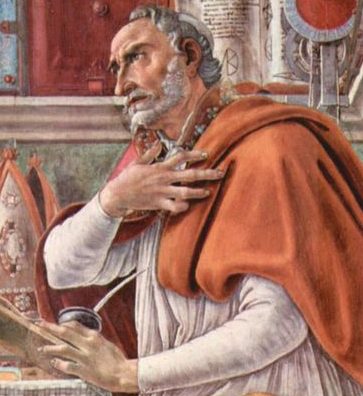
To understand the present, we must look towards the path. Today we look at Augustine of Hippo, a thinker who’s writings had a large and crucial influence on the development/formulation of the Roman Catholic Church and through this the entire Christian religion. This makes Augustine still very relevant today. But not only was he a very authorative voice in religion, he has also been an important figure in philosophy. He is one of the first thinkers to practice philosophy as a sort of everyday exercise, influencing the practice of philosophy. He also worked in a different manner than for example Aristotelians did, Augustine wrote on topics he himself enjoyed, and wrote on these. He had a different and more chaotic way of doing philosophy, changing the way philosophy was done since antique times. We can also still see relevance of topics he wrote on today:
An important topic in his works is the problem of evil or theodicy: why would God allow his creatures to suffer? In the present we still think about evil, not in a theological sense prese but more in a moral sense. For Augustine, evil is a purely human event which comes from a lack that is inherent in us. We humans attach value to material things, which turns us away from the immaterial world of God. When we lose these material things, we call this evil. Even more than we did in the time of Augustine, we live in an extremely materialistic world. We want the newest iPhone, the most expensive sneakers and a beautiful house. When we lose those things, or never obtain them in the first place we see this as bad, as evil. For Augustine this makes us turn away from God. In our secularized society maybe it is not about turning away from God exactly, but putting so much value on material things does make you turn away from other things in life. We lose the ability to place value on the immaterial, which does not perish. We only look at the screen of our iPhone and forget to look at the world around us, seeing all its beauty. By putting so much value on material things we can lose, maybe we indeed would be happier focusing on the immaterial.
People nowadays often forget that many of the values and ideas we hold now, have an origin found in religion. They forget that ideas formulated in the medieval centuries still hold, though sometimes hard to distinguish. Though religion is not the only source for modern values, it was an active one. During the middle ages, the world was sacralized, and philosophy was a way to serve religion. We now see a believe that we are very rational, and that our values are often based on the rationalism and separate from religious ideas. During the middle ages, emotivism ruled. Emotivism is the idea that emotions decide what actions you will take, not logic. Reason is submissive to emotion; emotion determines our thinking. You can only act rationally, if your emotions support your action. Philosophy ruled as the intellectual manifestation of religion, rational arguments were used to support religions ideas, this was called theurgy. It is of course still debated whether people are rational / or emotional, but overall we see people can also still act based on emotions. Ideas like ‘good’ and ‘bad’ often have their origins in religious ideas. One need only look at modern law and see many religious ideas manifested here. One can look for example at the seven deadly sins, Avaritia, greed which brings about crimes such as theft, can be seen in laws about theft of course. Luxuria, lust, we can see in in laws about sexual abuse. But also modern values about being hard working are based on Acedia.
What is also often forgotten, is that what we call ‘western society’ involves many ideas based on Arab culture/civilization. There was no such thing as a distinction between western and eastern civilization, many pillars of our society have origins in Jewish and Muslim culture. But what we currently see in the world, manifested in Islamophobia are ideas that Arab/Muslim culture is backward and subordinate to western society. Which is ironic, seeing how many of western culture has origins in Arab culture.

 An Introduction to Medieval Philosophy