We have come to the end of the course medieval philosophy, and a fitting end it is. We end with political philosophy and ethics, just like Al-Farabi would have done through his enumeration of the sciences. But in this blogpost, I want to shortly reflect on what this course has meant to me. In general,Meer lezen over “Lecture 11 & 12. The Final Blog”
Auteur archief:hannahbaars
Lecture 10. Thomas Aquinas and revelation
Today we are discussing one of the most influential theologians and philosophers throughout time: Thomas Aquinas. We focus on his union of reason and religion. Aquinas argues that new knowledge in theology is obtained through revelation. Revelation is the process where divine truth is communicated to humans through God. But how is thinking of somethingMeer lezen over “Lecture 10. Thomas Aquinas and revelation”
Lecture 9. Moses Maimonides and the therapeutic experience of shopping
Today I will be doing something a bit different, I will be writing a reaction to something said in the lecture. In the lecture was mentioned how some people find shopping to be therapeutic, and that those people are shallow and superficial. I will make an argument why people are allowed to find shopping justMeer lezen over “Lecture 9. Moses Maimonides and the therapeutic experience of shopping”
Lecture 8. The Making of the Jewish Philosophical Tradition
Ask a person about the Age of Enlightenment and they will undoubtedly tell you about how this was the period when reason became the main way to obtain knowledge. Sometimes it even seems like people believe that during the Enlightenment reason was invented! As if it had never existed before only now came in toMeer lezen over “Lecture 8. The Making of the Jewish Philosophical Tradition”
Lecture 7. Al-Ghazali on the incoherence of the philosophers
From the day we are born, we learn. We have been taught to speak, think and act in certain ways. We go to school and they will tell you: this is how history happened, this is how math works and this is how our society works. We learn and we study, and we accept thatMeer lezen over “Lecture 7. Al-Ghazali on the incoherence of the philosophers”
Lecture 5. The second master
“It is wrong for the virtuous man to remain in the corrupt polities, and he must emigrate to the ideal cities, if such exist in fact in his time. If they do not exist, then the virtuous man is a stranger in the present world and wretched In life, and to die is preferable forMeer lezen over “Lecture 5. The second master”
Lecture 4. Medieval logic
A crucial branch of philosophy is logic, which is still very relevant today. It has been around for many centuries and has been very much discussed in medieval times of course. It has of course changed over times, just as its purpose has changed. But what has not changed is that it helps us strengthenMeer lezen over “Lecture 4. Medieval logic”
Lecture 3. Boethius and Lady Philosophy
In our journey that is medieval philosophy, we have arrived at the Roman thinker Boethius. An important man for us, since he has had a large impact on philosophy, for example by translating many Greek works into Latin, forming a sort of bridge between ancient and medieval philosophy. Today we discuss his work: ‘The ConsolationMeer lezen over “Lecture 3. Boethius and Lady Philosophy”
Lecture 2. Augustine, free will and evil
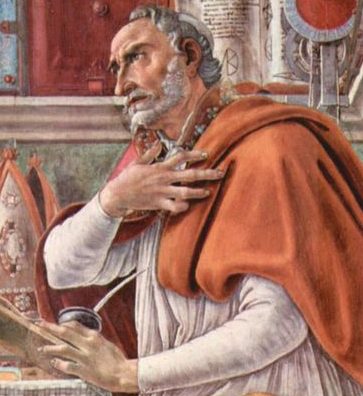
To understand the present, we must look towards the path. Today we look at Augustine of Hippo, a thinker who’s writings had a large and crucial influence on the development/formulation of the Roman Catholic Church and through this the entire Christian religion. This makes Augustine still very relevant today. But not only was he aMeer lezen over “Lecture 2. Augustine, free will and evil”
Lecture 1. What is philosophy in the Medieval Period?
People nowadays often forget that many of the values and ideas we hold now, have an origin found in religion. They forget that ideas formulated in the medieval centuries still hold, though sometimes hard to distinguish. Though religion is not the only source for modern values, it was an active one. During the middle ages,Meer lezen over “Lecture 1. What is philosophy in the Medieval Period?”
 An Introduction to Medieval Philosophy