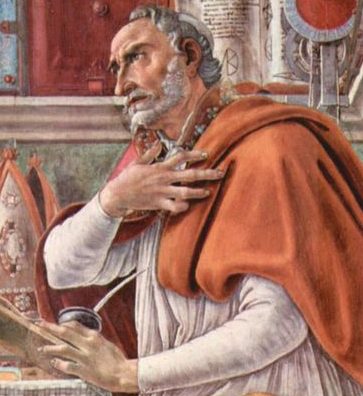
To understand the present, we must look towards the path. Today we look at Augustine of Hippo, a thinker who’s writings had a large and crucial influence on the development/formulation of the Roman Catholic Church and through this the entire Christian religion. This makes Augustine still very relevant today. But not only was he a very authorative voice in religion, he has also been an important figure in philosophy. He is one of the first thinkers to practice philosophy as a sort of everyday exercise, influencing the practice of philosophy. He also worked in a different manner than for example Aristotelians did, Augustine wrote on topics he himself enjoyed, and wrote on these. He had a different and more chaotic way of doing philosophy, changing the way philosophy was done since antique times. We can also still see relevance of topics he wrote on today:
An important topic in his works is the problem of evil or theodicy: why would God allow his creatures to suffer? In the present we still think about evil, not in a theological sense prese but more in a moral sense. For Augustine, evil is a purely human event which comes from a lack that is inherent in us. We humans attach value to material things, which turns us away from the immaterial world of God. When we lose these material things, we call this evil. Even more than we did in the time of Augustine, we live in an extremely materialistic world. We want the newest iPhone, the most expensive sneakers and a beautiful house. When we lose those things, or never obtain them in the first place we see this as bad, as evil. For Augustine this makes us turn away from God. In our secularized society maybe it is not about turning away from God exactly, but putting so much value on material things does make you turn away from other things in life. We lose the ability to place value on the immaterial, which does not perish. We only look at the screen of our iPhone and forget to look at the world around us, seeing all its beauty. By putting so much value on material things we can lose, maybe we indeed would be happier focusing on the immaterial.
 An Introduction to Medieval Philosophy